
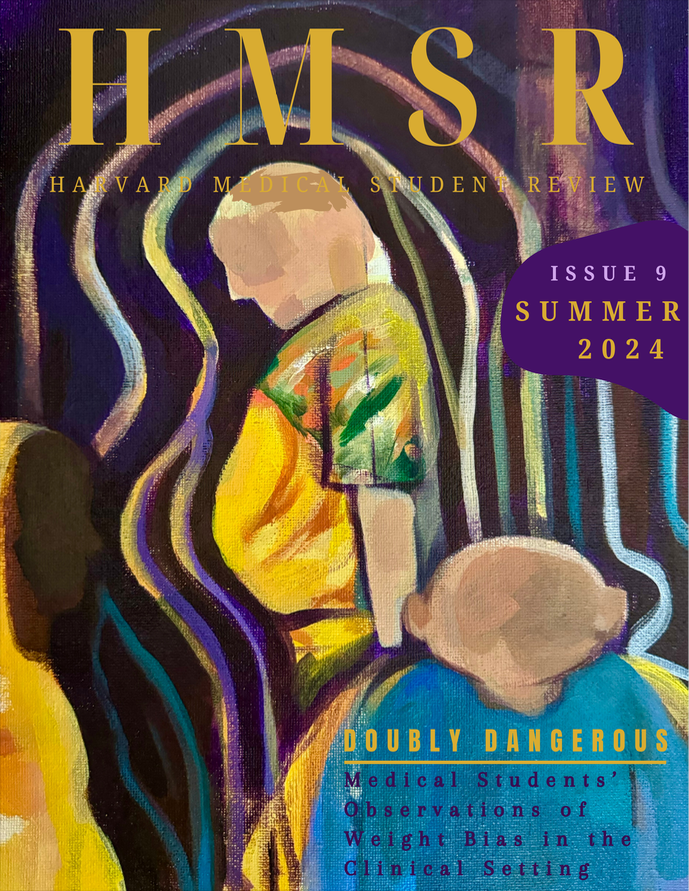
Doubly Dangerous: Medical Students’ Observations of Weight Bias in the Clinical Setting
DOI:
https://doi.org/10.65539/z2d2r747Keywords:
weight bias, obesity stigma, medical ethics, medical education, BMIAbstract
Weight bias is pervasive in clinical encounters yet remains underaddressed in medical education. Drawing on vignettes from their clerkship year, the authors illustrate how stigmatizing assumptions about patients with higher body mass index (BMI) can violate core ethical principles of justice, autonomy, and non-maleficence. They describe how biased narratives about an IVF patient, a transgender man on gender-affirming hormone therapy, and a child labeled “obese” both harm patients and normalize discriminatory practices among trainees. The essay argues for a weight-neutral, evidence-based approach that centers patient values, promotes respectful communication, and explicitly teaches students to recognize and resist weight stigma in clinical training and practice.
Downloads
References
Rubino F, Puhl RM, Cummings DE, et al. Joint international consensus statement for ending stigma of obesity. Nat Med. 2020;26(4):485–497. doi:10.1038/s41591-020-0803-x DOI: https://doi.org/10.1038/s41591-020-0803-x
United States National Commission for the Protection of Human Subjects of Biomedical and Behavioral. The Belmont Report: Ethical Principles and Guidelines for the Protection of Human Subjects of Research: Appendix. Department of Health, Education, and Welfare, National Commission for the Protection of Human Subjects of Biomedical and Behavioral Research; 1978.
Bertakis KD, Azari R. The impact of obesity on primary care visits. Obes Res. 2005;13(9):1615–1623. doi:10.1038/oby.2005.198 DOI: https://doi.org/10.1038/oby.2005.198
Fruh SM, Nadglowski J, Hall HR, Davis SL, Crook ED, Zlomke K. Obesity stigma and bias. J Nurse Pract. 2016;12(7):425–432. doi:10.1016/j.nurpra.2016.05.013 DOI: https://doi.org/10.1016/j.nurpra.2016.05.013
Hebl MR, Xu J. Weighing the care: physicians’ reactions to the size of a patient. Int J Obes Relat Metab Disord. 2001;25(8):1246–1252. doi:10.1038/sj.ijo.0801681 DOI: https://doi.org/10.1038/sj.ijo.0801681
Phelan S, Burgess D, Yeazel M, Hellerstedt W, Griffin J, van Ryn M. Impact of weight bias and stigma on quality of care and outcomes for patients with obesity. Obes Rev. 2015;16(4):319–326. doi:10.1111/obr.12266 DOI: https://doi.org/10.1111/obr.12266
Huizinga MM, Cooper LA, Bleich SN, Clark JM, Beach MC. Physician respect for patients with obesity. J Gen Intern Med. 2009;24(11):1236–1239. doi:10.1007/s11606-009-1104-8 DOI: https://doi.org/10.1007/s11606-009-1104-8
Gudzune KA, Bennett WL, Cooper LA, Bleich SN. Patients who feel judged about their weight have lower trust in their primary care providers. Patient Educ Couns. 2014;97(1):128–131. doi:10.1016/j.pec.2014.06.019 DOI: https://doi.org/10.1016/j.pec.2014.06.019
Alberga AS, Edache IY, Forhan M, Russell-Mayhew S. Weight bias and health care utilization: a scoping review. Prim Health Care Res Dev. 2019;20:e116. doi:10.1017/S1463423619000227 DOI: https://doi.org/10.1017/S1463423619000227
Kniess J. Obesity, paternalism and fairness. J Med Ethics. 2015;41(11):889–892. doi:10.1136/medethics-2014-102537 DOI: https://doi.org/10.1136/medethics-2014-102537
Tomiyama AJ, Mann T. If shaming reduced obesity, there would be no fat people. Hastings Cent Rep. 2013;43(3):4–5; discussion 9–10. doi:10.1002/hast.166 DOI: https://doi.org/10.1002/hast.166
Vogel L. Fat shaming is making people sicker and heavier. CMAJ. 2019;191(23):E649. doi:10.1503/cmaj.109-5758 DOI: https://doi.org/10.1503/cmaj.109-5758
Warbrick I, Came H, Dickson A. The shame of fat shaming in public health: moving past racism to embrace indigenous solutions. Public Health. 2019;176:128–132. doi:10.1016/j.puhe.2018.08.013 DOI: https://doi.org/10.1016/j.puhe.2018.08.013
Kersbergen I, Robinson E. Blatant dehumanization of people with obesity. Obesity. 2019;27(6):1005–1012. doi:10.1002/oby.22460 DOI: https://doi.org/10.1002/oby.22460
Drury CAA, Louis M. Exploring the association between body weight, stigma of obesity, and health care avoidance. J Am Acad Nurse Pract. 2002;14(12):554–561. doi:10.1111/j.1745-7599.2002.tb00089.x DOI: https://doi.org/10.1111/j.1745-7599.2002.tb00089.x
Koball AM, Mueller PS, Craner J, et al. Crucial conversations about weight management with healthcare providers: patients’ perspectives and experiences. Eat Weight Disord. 2018;23(1):87–94. doi:10.1007/s40519-016-0304-6 DOI: https://doi.org/10.1007/s40519-016-0304-6
Puhl RM, Gold JA, Luedicke J, DePierre JA. The effect of physicians’ body weight on patient attitudes: implications for physician selection, trust and adherence to medical advice. Int J Obes. 2013;37(11):1415–1421. doi:10.1038/ijo.2013.33 DOI: https://doi.org/10.1038/ijo.2013.33
Kannan VD, Veazie PJ. Predictors of avoiding medical care and reasons for avoidance behavior. Med Care. 2014;52(4):336–345. DOI: https://doi.org/10.1097/MLR.0000000000000100
Vartanian LR, Smyth JM. Primum non nocere: obesity stigma and public health. J Bioeth Inq. 2013;10(1):49–57. doi:10.1007/s11673-012-9412-9 DOI: https://doi.org/10.1007/s11673-012-9412-9
Himmelstein MS, Puhl RM, Quinn DM. Intersectionality: an understudied framework for addressing weight stigma. Am J Prev Med. 2017;53(4):421–431. doi:10.1016/j.amepre.2017.04.003 DOI: https://doi.org/10.1016/j.amepre.2017.04.003
Paine EA. “Fat broken arm syndrome”: negotiating risk, stigma, and weight bias in LGBTQ healthcare. Soc Sci Med. 2021;270:113609. doi:10.1016/j.socscimed.2020.113609 DOI: https://doi.org/10.1016/j.socscimed.2020.113609
Troop N, Baker A. Food, body, and soul: the role of disgust in eating disorders. In: Disgust and Its Disorders: Theory, Assessment, and Treatment Implications. American Psychological Association; 2009:229–251. doi:10.1037/11856-011 DOI: https://doi.org/10.1037/11856-011
Goss K, Allan S. Shame, pride and eating disorders. Clin Psychol Psychother. 2009;16(4):303–316. doi:10.1002/cpp.627 DOI: https://doi.org/10.1002/cpp.627
Palad CJ, Yarlagadda S, Stanford FC. Weight stigma and its impact on paediatric care. Curr Opin Endocrinol Diabetes Obes. 2019;26(1):19–24. doi:10.1097/MED.0000000000000453 DOI: https://doi.org/10.1097/MED.0000000000000453
Tylka TL, Annunziato RA, Burgard D, et al. The weight-inclusive versus weight-normative approach to health: evaluating the evidence for prioritizing well-being over weight loss. J Obes. 2014;2014:983495. doi:10.1155/2014/983495 DOI: https://doi.org/10.1155/2014/983495
Matheson EM, King DE, Everett CJ. Healthy lifestyle habits and mortality in overweight and obese individuals. J Am Board Fam Med. 2012;25(1):9–15. doi:10.3122/jabfm.2012.01.110164 DOI: https://doi.org/10.3122/jabfm.2012.01.110164
Published
Issue
Section
License
Copyright (c) 2024 Meghana Vagawala, Alison Mosier-Mills, Bethany Brumbaugh (Author)

This work is licensed under a Creative Commons Attribution-NonCommercial 4.0 International License.